
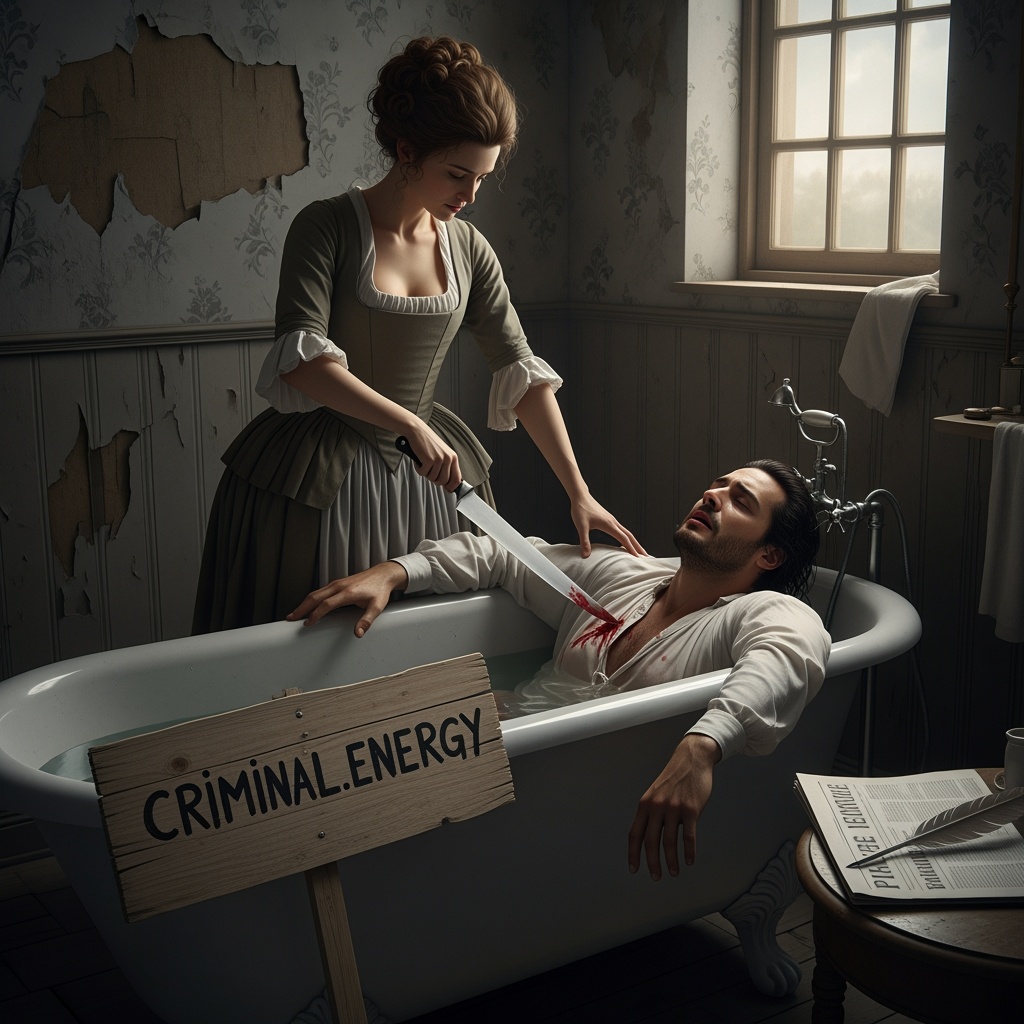
Charlotte Corday, born on July 27, 1768, in the French commune of Les Ligneries, is one of the most colorful figures of the French Revolution. Her name is forever linked to the murder of the radical journalist and politician Jean Paul Marat, an event that not only led to Corday’s execution but also influenced the course of the Revolution itself. Charlotte Corday came from an aristocratic family and was a descendant of the playwright Pierre Corneille. Her education was shaped by the ideas of the Enlightenment, which she learned about in her youth at a convent, where she studied the writings of great thinkers such as Rousseau and Voltaire. These Enlightenment ideals led to her opposition to the extreme currents of the Revolution. While she initially welcomed the revolution, she soon began to turn away from the radical Jacobins, especially Marat, who was known among the population as the “Friend of the People.” Her brothers were passionate royalists and emigrated, which shaped her increasingly royalist and moderate views. Corday’s rejection of the Jacobins was reinforced by the brutal political struggles during the revolution. The Girondists, with whom she sympathized, rapidly lost influence to the radical Montagnards. During this turbulent period, the National Convention represented the moderate forces, which were pressured by the so-called Sansculotte militias, the Parisian petty bourgeois and working-class forces, leading to massive bloodshed. Corday, convinced by her views and the feeling that the ideals of the Enlightenment had been betrayed, decided that decisive action was necessary to stop this terror. Her goal was to kill Marat, whom she considered primarily responsible for the violence and bloodlust of the Jacobins. She wrote in a later letter that she believed that by murdering Marat, she would initiate the possibility of a counterrevolution and restore peace in France. For Corday, the murder was not only a criminal act, but a patriotic duty for which she was willing to pay with her life. The sequence of events leading up to the assassination is well documented and shows Corday’s determination. On July 9, 1793, she traveled from Caen to Paris, where she took a hotel room. She had already applied for a passport and made all the necessary preparations to assassinate Marat. On July 13, 1793, the eve of the attack, she bought a kitchen knife and wrote a letter to the French people explaining her motives. Under the pretext of providing information about the Girondists, she managed to gain access to Marat’s apartment. When she finally met Marat, who was sitting in a bathtub, it was the moment of her life. In a brief conversation, she pretended to provide information about an impending conspiracy. When Marat assured her that he would write down the names of the Girondists who had fled, Corday stabbed him with the knife. The attack was brutal and direct. She wounded Marat so severely that he died in the bathtub. Corday was caught at the scene by the National Guard. Corday’s determination and cold-bloodedness in such a moment left a deep impression on her contemporaries. Reactions to Corday’s act were mixed. Many saw her as a heroine who had the courage to fight against the tyrannical regime of the Jacobins. Others condemned her as a murderer who had to be held accountable for her actions. The assassination made Marat a martyr of the French Revolution. Corday’s trial took place quickly. Corday appeared fearlessly before the revolutionary tribunal and defended her actions as a patriotic act. Her argument that she had killed Marat to save many others was met with both approval and outrage. Corday said, “I killed one man to save a hundred thousand.” On July 17, 1793, Corday was sentenced to death. Her last wish was to be portrayed by an officer of the National Guard. In a final letter, she asked her father for forgiveness and declared that she was proud of her actions. Despite her imprisonment, she showed no remorse and insisted that she had killed Marat not for personal reasons, but for the good of the country. Charlotte Corday’s execution took place on the evening of July 17, 1793. Her final journey to the scaffold was accompanied by a crowd that showered her with insults. Despite the hatred of the spectators, Corday remained composed. It is said that she placed her head under the guillotine herself, reflecting her unyielding character. After her death, her body was buried in a mass grave. The circumstances of her burial are unclear, and rumors suggest that her head was kept as a curiosity and remained in the possession of the Bonaparte family until the 20th century. Charlotte Corday’s actions and fate raise several questions. Was she truly a heroine, or was she merely a tragic figure in a game of power and violence? Her action can be seen both as an act of resistance against a tyrannical government and as a sign of fanaticism. In retrospect, her person and her deeds reveal the complexity of human morality in times of political unrest. Corday remains an example of the deep conflict between individual conviction and the mass movements of history. In modern historiography, Charlotte Corday is often regarded as a symbol of resistance against tyranny. Her life and death represent the combative spirit of a woman who was willing to sacrifice everything for her convictions. Her figure has found its place in literature, art, and culture and continues to inspire debates about the role of women in revolutionary movements and the limits of resistance against oppression. In 1847, the writer Alphonse de Lamartine posthumously gave her the nickname “l’ange de l’assassinat,” the “angel of assassination.” Charlotte Corday is undoubtedly a multifaceted and complex figure in French history. Her murder of Jean Paul Marat represents a pivotal moment during the French Revolution and has occupied generations of historians, writers, and philosophers. Her legacy lives on in discussions of justice, morality, and the right to resistance, and she remains an indispensable part of the narrative of freedom and tyranny in the 18th century and beyond.

By Isabella Mueller
Welcome to my journey through creativity and discovery! My name is Isabella Mueller, and I invite you to explore the fascinating creative universes I create through my blogs. Since 2020, I have been dedicating my passion to telling captivating stories that are mysterious, historical, and emotional. My goal is not only to entertain, but also to inspire reflection and awaken the spirit of discovery in each of us. At isabellas.blog, the suspense of crime stories is combined with exciting travel tips. Imagine wandering through the picturesque streets of a new city, uncovering dark secrets hidden in the shadows of its history. Every piece on my blog is designed to make the heart of every crime fiction fan beat faster while sparking curiosity about unknown places. Here, you are invited to experience the thrill of the unknown and the beauty of our world—a perfect combination for all adventure seekers! My second blog, akteq.com, is all about true, unsolved crime stories. Under the motto “akteQ: Cold Case Stories,” I reveal the eerie and often tragic stories behind unsolved cases. Together, we can explore the mysteries of the past and delve deep into the human psyche. What really happened? Who were the people behind these mysterious events? In this blog, I invite you to ask questions and find the answers that often remain hidden in the dark. You can find another exciting chapter in my blogging career at thecastles.org. Here, I embark on an enchanting journey through the history of castles and palaces. Pause for a moment as you discover the stories hidden within the walls of these ancient structures. “Explore the enchantment, discover the history – your journey begins at thecastles.org!” These words are more than just a slogan; they are an invitation to anyone who wants to combine history and magic. Be inspired by the impressive stories and the fascination of bygone eras! But that's not all! At kripo.org, you'll find a comprehensive online magazine for real criminal cases. Immerse yourself in the world of crime, learn about the real stories behind the headlines and the people who are involved in solving them. With criminal.energy, I take you on a journey through the gripping stories of true crimes in which villains are hunted, caught, and convicted. The search for justice and the confrontation with the unknown are at the center of it all. TrueCrime Blog 187.news takes you into the depths of crime. And for those who want to travel the world, wanderlust.plus offers the opportunity to explore the world, one adventure at a time. It's all about the love of exploration and the joy of discovering new cultures and landscapes. Finally, truecrime.ch invites you to discover the dark side of Switzerland and Europe: true crimes, true stories. Let's discover together the stories that shape the world around us. I look forward to accompanying you on this exciting journey and hope you will share many unforgettable moments with me!